Designing Engagement Spaces in Memory Care: The Third Place Opportunity
In institutional care settings (whether memory care, assisted living, or even supporting someone aging in place), people live in environments where "home" and "care" are one and the same. There's no coffee shop to go to, no library for quiet reflection, no park bench for watching the world go by. Sociologist Ray Oldenburg called these informal gathering spaces "third places": the social environments separate from home (first place) and work (second place) that are essential for community, conversation, and wellbeing.
But what does a "third place" look like when someone can't leave the building? When cognitive impairment means they need support to navigate even familiar spaces?
Drawing on 30+ years as an interaction designer, including 17 years creating museum exhibitions, I approached this challenge by asking: what spatial and experiential design principles create meaningful engagement across diverse abilities? I explored this through the Memory Care Experience Station, a five-year pilot at San Francisco Campus for Jewish Living involving 200 engagement sessions.
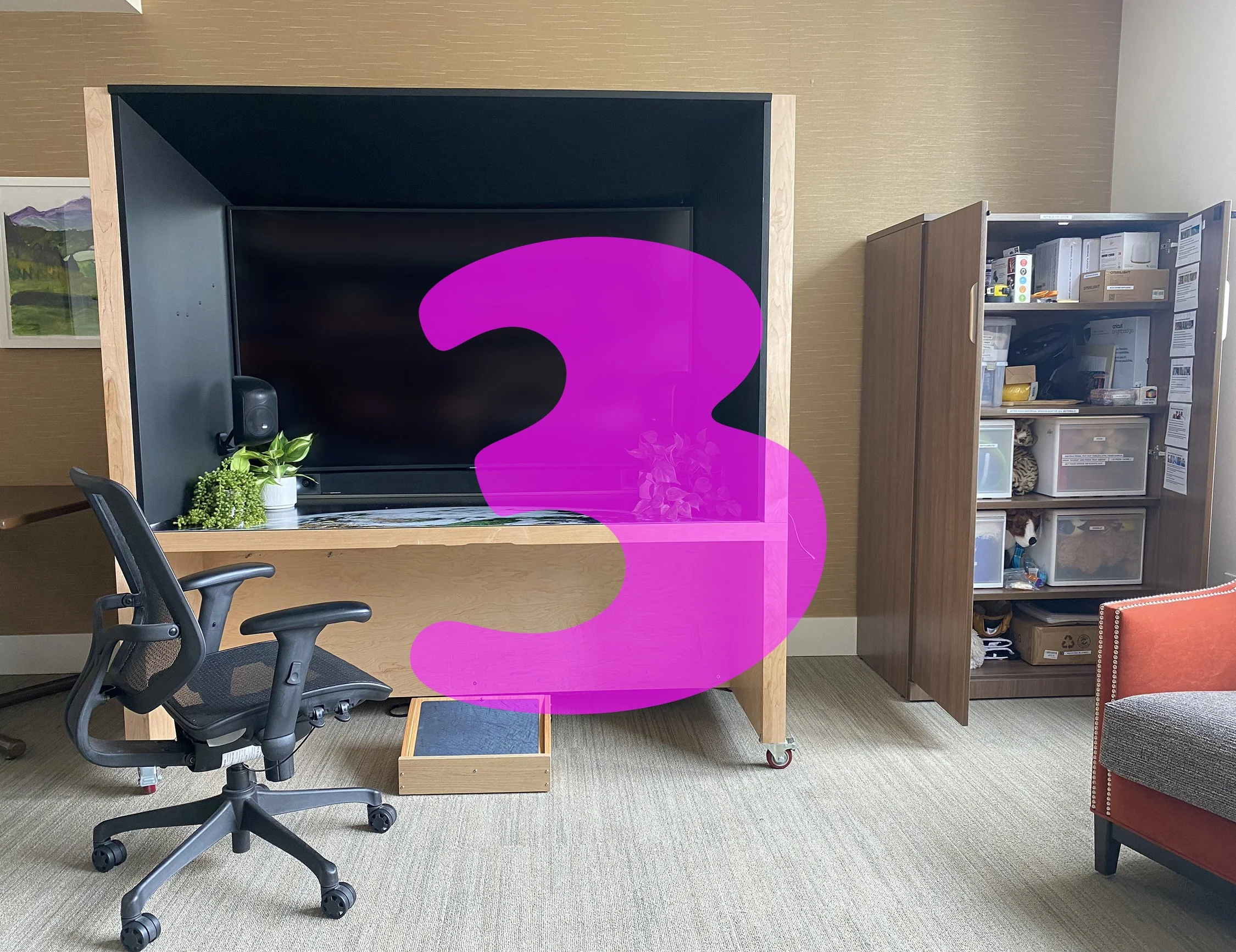
The Station pilot in standby mode at SFCJL
A dedicated engagement space can be a room, an area in a larger space that can be “sheltered” from other activities, or an installation such as this.
How sensorially designed spaces in memory care relate to Ray Oldenburg's "third place" concept
Ray Oldenburg, the urban sociologist, defined third places as neutral ground where people gather voluntarily, where conversation is the main activity, where it's accessible and welcoming. But residents in memory care can't freely come and go. They often need assistance just to move between their room and common areas. They can't hop over to a café when they need a change of scene.
These aren't true 'third places' by Oldenburg's strict definition—residents can't freely come and go, and access requires staff or loved one facilitation. But they serve an analogous psychological function: spaces that feel separate from care routines, that signal 'this is a place to relax and be together,' that provide a sense of escape and personhood.
I think we need to expand how we think about third places to include institutional contexts. These engagement spaces address what I call the "third place opportunity" in care environments. And even those at home.
What led me to design something different from Life Stations or other types of enrichment interactives
Most memory care facilities have either group activity programs (bingo, sing-alongs, group exercises) or "sensory rooms" designed primarily for soothing, often based on the Snoezelen model. Both have value, but there's a gap in between.
Traditional activity rooms often have a hodgepodge approach—sometimes called 'life stations'—such as a gardening table. Adjacent to that might be a cooking table next to a woodworking setup. These tend to be single-user, single-note activities that can feel infantilizing. They're often not real enough, not multisensory enough, and not personalizable to disease progression, state of mind, or individual preferences.
Snoezelen rooms focus on calming. Soft lighting, gentle sounds, passive engagement. They're valuable for behavioral management. But research on multisensory stimulation shows people with dementia need both calming and stimulating experiences, personalized to the individual and adaptable to their changing needs (Sánchez et al., 2012; Mortati, 2023).
What was unprecedented about our approach was the combination of a dedicated space (the corner of a family lounge), an adaptable platform with personalized content that enhance staff-mediated enrichment plus spectrum of engagement possibilities. Not just soothing, one-note activities, but a system that could intimately meet someone where they are on any given day.
Timeline
I want to credit SFCJL and their funders, particularly the Centre for Advancement and Brain Health Innovation (CABHI) and the Sephardic Foundation on Aging, for supporting this longitudinal pilot. The project began in 2018, and I came on board in late 2019. The facility opened in September 2020. We conducted proof of concept work through 2021 under extreme pandemic restrictions. The full pilot launched in late 2022, with intensive work in 2023 and wrap-up in 2024.
SFCJL invested in figuring this out over multiple phases so others don't have to start from scratch. Another facility building on this wouldn't need this timeline—we learned what works so they can implement more quickly.
Three reasons we needed that initial duration:
Designing for multiple stakeholders simultaneously: leadership and funders who needed to see viability, staff who needed workflows that fit their reality, residents who were the beneficiaries, and families who wanted meaningful ways to connect with their loved ones. That's a complex ecosystem with sometimes competing needs.
Working in a new facility with no established patterns during a pandemic. We were learning alongside them: how do staff schedules work? What are the facilities' maintenance realities? Where are the noise and distraction patterns throughout the day?
Designing for a progressive disease. What works for someone today may not work in three months. We needed to understand how individuals' needs changed over time and how the platform could adapt.
What we learned iterating with 200 sessions (that we couldn't learn in 20 or 50)
When creating something entirely new in a new facility in a complex context, sustained presence mattered.
Staff workflows were constantly evolving. We had to carefully refine everything from content selection to sensory inputs to the physical setup for different users. We developed a tracking system so staff could document observations for resident reports. We created signage and maintenance protocols. We built experience playlists and backend organization so we could enable staff to do what I'd been doing during development. We were iterating the design on two fronts: the functional side and the staff workflow side.
We learned critical details about consumables and equipment. Early on, we had a wind effect in the pilot and discovered over time that residents with dry eye were affected by it. We also had automatic scent emitters. Both put pressure on staff to orchestrate complex elements during sessions or manage consumables. We removed the wind and transitioned to scents via familiar props staff could easily manage. Such as spice jars, live plants, and perfume. Much easier, more cost-effective, and more resonant for residents.
While we designed the pilot to support staff satisfaction, turnover is inevitable. We developed thorough documentation and training protocols to ensure the system could work with changing personnel.
For a fairly large innovation in this type of environment, insights don't emerge quickly. You need sustained observation across different conditions, different staff, different seasons, different stages of disease progression.
Why a dedicated or sheltered space matters
The data across this many sessions showed clearly: we needed sheltered-enough or dedicated space to increase the success rate for residents to focus on the experience, on the staff or family member they were with, on whatever was at hand.
There are several mechanisms at work:
Filtering sensory inputs. People with dementia need space to orient themselves to an activity. That takes time, both physically moving to the space and verbally being brought into the experience by staff. Competing noises and visual distractions in general common areas make that orientation much harder.
Creating psychological safety. While many residents may not remember a specific activity or even coming to the Station, many recalled having a pleasurable time there. Families and loved ones definitely remembered. The space itself became associated with positive experiences.
Enabling intimate, social connection. This is about having enough perceived privacy for 1-on-1 or small group interaction. It's where social connection and comfortable closeness can happen. Staff can sit close, family members can hold hands, there's space for the human connection that is itself therapeutic.
Interestingly, the precedent of Snoezelen rooms showed us that sheltering from distractions is essential for soothing someone. What we learned is that sheltering is equally important for engaging someone. The underlying mechanism is the same: orientation to the activity and enough quiet to have an intimate experience.
Location, maintenance, and complexity
Location matters profoundly. We initially had the Station near an entrance to the memory care wing, just outside a locking door and near the staff break room. Staff were parking their large, noisy carts right outside. The door was very loud when closing. It also had an alarm that would go off when someone needed more than a few seconds to get through it. All of this disrupted sessions. We learned that when you're siting an engagement space, you have to map the noise and traffic patterns of the facility, not just at one time of day, but throughout daily routines. This sounds obvious, but it's essential to track these details when creating therapeutic environments.
Maintenance requirements are design requirements. From my museum work, I knew to ensure all surfaces were easy to clean, that there was a "kick" (like in kitchen cabinetry) so vacuums could fit underneath, that there was ample space for equipment to maneuver. Supplies needed to be organized and adjacent to the space, with reliable sourcing systems for refreshing. Nothing too exotic. These aren't afterthoughts. They're core design specifications that determine whether staff can actually maintain the space over time.
Complexity is the enemy of sustainability. The wind effect and automatic scents I mentioned earlier are perfect examples. They seemed like good ideas (multisensory, controllable) but they added layers of complexity that staff had to manage during sessions. When you're working with someone with dementia, you can't be fiddling with equipment. Simplifying to props residents already understood (spice jars, plants) made everything more manageable and more effective.
Actual spatial performance requirements for an engagement space
Based on what we learned, here are the key requirements for what the space needs to do or support:
Sensory Control: The ability to mediate strong noises and visual distractions. This might mean acoustic dampening, strategic location away from high-traffic areas, doors that close quietly, or visual screening.
Perceived Privacy: Enough sense of being in a contained, intimate setting. Not necessarily a separate room (though that helps) but enough enclosure that residents and families feel they're in their own space and can orient their attention appropriately.
Relational Function: Physical support for social connection and comfortable closeness, whether 1-on-1 or small group. This means comfortable seating that allows people to sit close, space for a staff member or family member to be next to (not across from) the resident, room for maneuvering wheelchairs without feeling cramped.
Psychological Signaling: The space needs to communicate "this is a place to relax and be together." It should feel distinct from care routines. This might be through lighting, decor, or simply being separate from where medications are administered or ADLs happen.
Adaptability Infrastructure: Base components that allow for personalization plus the ability to display scenery and props. If you're using something like our Experience Station pilot (which functions like a combination of mini theater and workspace), you need flexibility to change what's shown and used based on individual preferences.
These aren't aesthetic considerations. They're functional requirements. A planner or architect should be able to use these as a checklist.
What the next facility can do:
The gift SFCJL and their funders gave to the field was providing the will and funding to prove the concept, work out the kinks, and establish what infrastructure and workflows actually work. Another facility can build on that foundation.
That said, every facility is different. What I'd strongly recommend:
Start with low-stakes, frontline staff conversations. 1-on-1, or group meetings without managers or directors. Ask them: What would make your work easier? What's frustrating about current activity spaces? What do residents respond to? Then do a "we heard this, anything else?" follow-up. Email, a survey, it doesn't matter. This is crucial and will help you avoid building something you'll have to tear out or that sits unused.
Try bodystorming, which is a technique where you physically move through an activity before the space exists. Put a piece of paper on the ground or wall showing where things will be located. Have staff walk through it multiple times, simulating real sessions: where do they stand, how do they reach supplies, where does the resident sit, can a wheelchair maneuver? Then bring in facilities staff to test cleaning access. Do it with life enrichment first, then facilities. If you're feeling generous, even family advisors.
Consider an experience designer early. Architects design buildings, OTs design care plans, but experience designers think about the whole ecosystem: users, stakeholders, systems over time. Even a short consultation at the planning phase can save enormous expense and frustration later.
A simple thing the next designer can do:
At the outset, understand that you'll need to help your client know the what's and why's of this type of design and design process. Make space for clarifying questions. Ensure your proposal is educational, not solely factual.
If you are caring for someone at home, this is how it could apply to you:
The spatial performance requirements apply whether you're designing an institutional space or adapting a home.
For someone aging in place, an engagement space might be a corner of the living room that's set up differently, with good lighting, comfortable seating, and space for activities that feels separate from TV-watching or meal routines. Or a converted spare bedroom or office that becomes the "engagement room." Even a verbal introduction with a special food and content, or special blanket and adjustment of the TV can signal enough that this is special.
The same principles apply: reduce distractions, create perceived privacy for intimate connection, signal that this space is for enjoyment and togetherness, make it adaptable to changing needs.
Family caregivers especially need support and permission to create these spaces. There's often guilt about "taking over" parts of the home or spending money on "special" setups. But having a dedicated space where activities go well, where positive experiences happen, makes caregiving more sustainable and improves quality of life for everyone.
What can facilities do without a designer?
There's a lot facilities can DIY, especially if they approach it systematically.
Start small and test: Facilities can do those stakeholder conversations with frontline staff (again, those detailed, 1-on-1's), bodystorming exercises to test spatial concepts, basic infrastructure assessment using a checklist (see below), piloting with simple, low-tech interventions before investing in equipment, and observing noise and traffic patterns throughout the day to inform location decisions.
Build on what works: Use the spatial performance requirements above as a guide. Start with one element—maybe creating perceived privacy in a corner of an existing common room, or improving lighting in your current activity space. Document what changes and what improves. Add complexity only after simple interventions prove successful. Many facilities have created effective engagement spaces through this iterative, low-stakes approach.
What's harder without design expertise: understanding non-obvious interactions between spatial design, stakeholder needs, and engagement outcomes. Anticipating maintenance issues that only emerge over time. Balancing competing priorities across resident, staff, and operational needs. If your facility has the budget, bringing in an experience designer for even a brief consultation at the planning phase can save significant expense and frustration later.
The value of systems thinking is considering the whole ecosystem: space, equipment, content, workflows, training, maintenance, and how it all evolves over time. This is what makes interventions sustainable beyond the initial launch.
If you are a facility planner or funder looking at improvements in care, here are three things to consider:
First, recognize that engagement spaces are infrastructure, not amenities. They're as essential to wellbeing as proper lighting or accessible bathrooms. Budget for them accordingly, and design them with the same rigor you'd apply to clinical spaces.
Second, frontline staff are your experts. The people doing direct care know what works and what doesn't. Involve them from the beginning, listen to what they say, and design systems that make their work better. If it doesn't work for staff, it won't work for residents.
Third, you're not alone in figuring this out. The Memory Care Experience Station pilot at San Francisco Campus for Jewish Living, supported by CABHI and other funders, did the heavy lifting. The research exists (Mortati, 2023). The principles are transferable. You don't need years of development. You need to learn from those years and adapt the insights to your context.
The field is moving toward understanding that people with dementia need spaces designed for engagement. Spaces that respect their personhood, enable meaningful connection, and set the stage for moments of delight.
These engagement spaces seize what I call the 'third place opportunity' in institutional care. If you're designing, funding, or managing care environments, I'd love to learn what you have that works.
DIY Space Planning Checklist
Location Assessment:
Map noise sources throughout the day (carts, doors, alarms, staff areas)
Identify high-traffic areas to avoid
Check natural light availability and quality
Test door closure sounds and alarms
Verify distance from medical/ADL areas
Physical Infrastructure:
Power outlets accessible for equipment (within 6 feet of activity area)
Space for wheelchair maneuvering (at least 5-foot turning radius)
Seating that allows staff/family to sit beside (not just across from) resident
Storage for supplies within arm's reach
"Kick" space under furniture for vacuum access, ensure anything at floor level has a place to go or hang
Wall or display space for scenery/props
Easy-to-clean surfaces throughout
Engage IT:
Ensure you work with them early in the event you’re using hardware or software that isn’t cleared yet
Sensory Control:
Ability to moderate lighting (dimmers or multiple light sources)
Sound dampening (rugs, curtains, acoustic panels)
Visual screening from corridors or common areas
Option to close door or create sense of enclosure
Staff Workflow:
Supplies organized and clearly labeled
Signage for staff, facilities, families explaining space use
Space for staff to sit comfortably during session
Easy access from resident areas (not requiring long walks)
Clear sight lines for safety observation
Maintenance:
Cleaning protocols documented
Facilities staff consulted on requirements
Consumables easy to source locally
No exotic equipment requiring specialized service. Buy two of any key tech or gear in case it gets discontinued!
References & Further Reading
Third Place Theory:
Oldenburg, R. (1989). The Great Good Place. New York: Marlowe & Company.
Oldenburg, R., & Christensen, K. (2023). "Third places, true citizen spaces." UNESCO Courier. https://courier.unesco.org/en/articles/third-places-true-citizen-spaces
Multisensory Stimulation & Person-Centered Care:
Sánchez, A., Millán-Calenti, J.C., Lorenzo-López, L., & Maseda, A. (2012). Multisensory Stimulation for People With Dementia: A Review of the Literature. American Journal of Alzheimer's Disease & Other Dementias, 28(1), 7-14. https://doi.org/10.1177/1533317512466693
Fazio, S., et al. (2018). "The fundamentals of person-centred care for individuals with dementia." The Gerontologist, 58(Suppl 1), S10-S19.
Du Toit, S.H.J., et al. (2019). "Meaningful engagement and person-centered residential dementia care: A critical interpretive synthesis." Scandinavian Journal of Occupational Therapy, 26, 343–355.
Spatial Design & Multisensory Environments:
Prince, D.M., Fogarty, K.J., VanGeest, J.B., & Eberth, S.D. (2022). Using an Accessible Room Multisensory Stimulation Environment to Reduce Dementia Associated Behaviors. Journal of Long-Term Care, 289-297. https://doi.org/10.31389/jltc.151
Mortati’s Research:
Mortati, M. (2023). Designing for people living with dementia: Multisensory immersion. Design Principles and Practices: An International Journal -- Annual Review, 16, 131-149. [Common Ground Networks scholar site is down, url coming asap]
Mortati, M. (2022). Designing for People Living with Dementia: Principles for Experiential and Environmental Design. 16th International Conference on Design Principles and Practices.
Mortati, M. (2017). Experiencing the Art Museum: Methods for Public Engagement. In: Ciolfi, L., Damala, A., Hornecker, E., Lechner, M., & Maye, L. (Eds.), Museum Experience Design: Crowds, Ecosystems and Novel Technologies (pp. 97–114). Springer, Cham. https://doi.org/10.1007/978-3-319-58550-5
Additional Resources:
Design as Care blog: https://www.mortatidesign.com/design-as-care
Mortati Design: https://www.mortatidesign.com
Memory Care Experience Station: https://www.mortatidesign.com/projects/memory-care-experience-station
Citation for this post: Mortati, M. (2025). Designing Engagement Spaces in Memory Care: The Third Place. Design as Care. https://www.mortatidesign.com/design-as-care/third-place-opportunity